Why This Fails Locally
A lot of the commercial stock around Birmingham dates back to around 1960, which puts the original door hardware on borrowed time even if nobody's touched it since. If a building went up in that window and the door has never been swapped, there's a real chance the track brackets, the jamb hardware, or the header seal are still the parts that came with the building - not because anyone maintained them well, but because nobody had a reason to look. Cold-climate freeze-thaw cycling (this area sits in a severe cold band) works on steel and seals slowly over sixty-plus years, and it doesn't announce itself. You get a cable that's been fraying under paint, a track that's a quarter-inch out of plumb from decades of settling, or a bottom seal that's been letting water in since a Ford administration. None of that shows up on a walk-by inspection. It shows up when the door won't close on a Friday afternoon and the loading bay backs up. The fix isn't complicated once you're looking at it - it's finding it before it costs you a shift that's the hard part. Buildings this age also tend to have single-phase openers wired for loads that no longer match what's parked behind the door, which is its own separate conversation.
The DIY Question
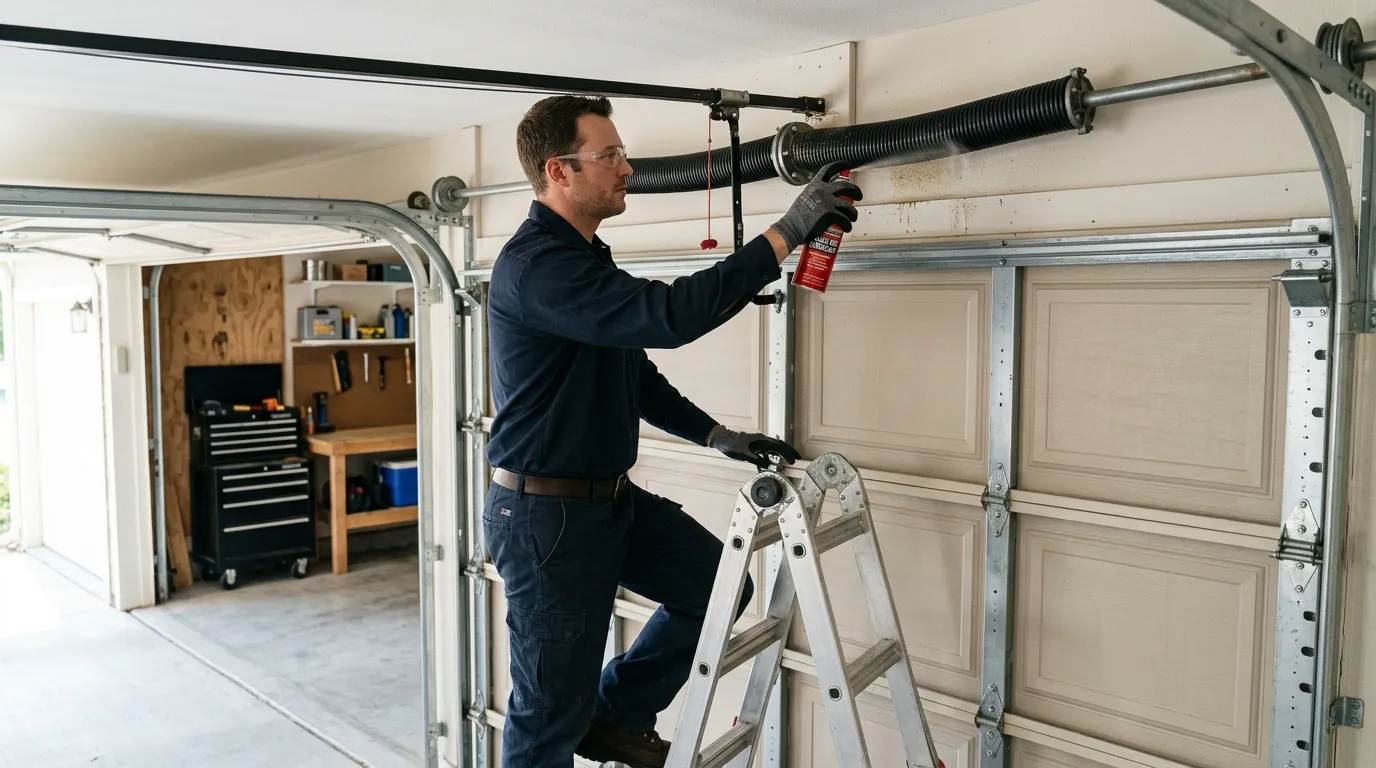
For a commercial door, the honest answer on DIY is mostly no, and the reason is liability, not skill. A torsion spring on a commercial door is bigger and wound tighter than anything on a house, and if you're not trained on it, you're betting a hospital trip against a part that costs less than the ER copay. Where DIY makes sense: swapping a photo-eye sensor, tightening a loose hinge screw, clearing debris out of the track. Where it doesn't: springs, cables, anything involving the torsion bar, or troubleshooting a commercial opener's control board. If your building's door is original to a 1960-era structure, assume the spring system has never been serviced and treat it as live hardware, not a weekend project. That's not caution for its own sake - it's what the wind-up force in an old, possibly fatigued spring actually does to a hand or a face if it lets go while you're standing in front of it.
What You Pay
Commercial repair pricing runs on parts and labor like any trade call, and we don't have a fixed number to quote you sight unseen - a bent track and a snapped spring are two different jobs. What's worth knowing about this specific area: median household income here runs well above the wider service area's $84,862 figure, and that tends to correlate with buildings where the owner opts for full hardware replacement over patchwork repair, since a five-year fix on a sixty-year-old track often costs more in return visits than doing it right once. That's not a sales pitch - it's what we see when jobs come from higher-income areas versus lower ones. If your door still runs original 1960-era hardware, ask for the replacement quote alongside the repair quote before you decide, because the math isn't always what you'd expect.
What Is on the Truck
For commercial calls out of Rochester Hills, the truck carries torsion springs in a range of common commercial sizes, cable stock, roller and hinge hardware, and photo-eye sensors for opener safety circuits - the parts that cover most day-to-day breakdowns. What it doesn't carry: nonstandard track sections or oversized commercial doors sized to specs from mid-century construction, since those aren't stock items anywhere. If a building's door turns out to need one of those, that's a second trip once the part's ordered, not a same-day fix - and we'll say so on-site instead of pretending otherwise.